Start with this question: what do you sell, who needs it, and what can it help them do? Put those answers into ordinary words. Then ask a likely customer to explain the sentence back to you. Their answer is more useful than another round of adjectives.
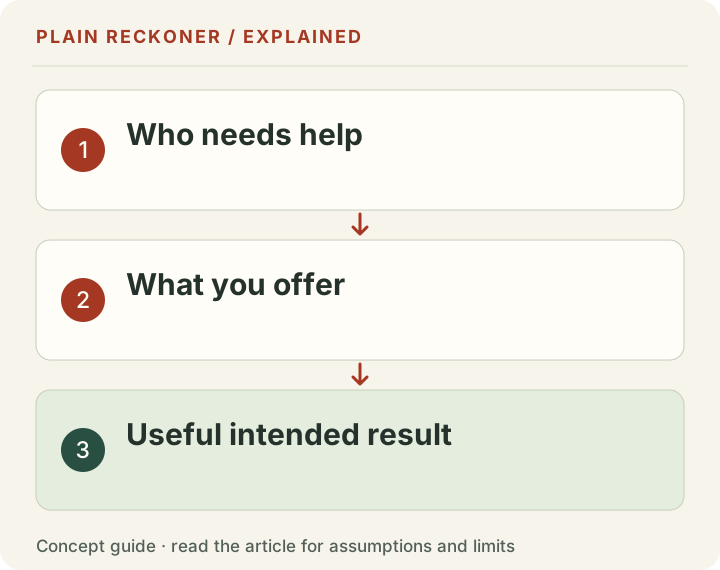
A practical first draft is: We help [customer] do [specific job] with [product or service]. It is a starting structure, not a rule that every business must follow. Sometimes naming the product first is clearer. Sometimes the location or a qualification matters more than the customer label.
Use the free Offer Builder to keep the parts together and edit a draft. This guide explains what to put into those parts, shows original examples and gives you a way to check the result without pretending that clearer wording guarantees more sales.
A business sentence is different from a slogan
A slogan can be memorable without explaining the offer. A business sentence has a more practical job: help someone decide whether you are relevant enough to investigate. It should survive being read without your logo, your photograph or a long spoken explanation.
Consider an original example: “Make every day matter.” That could belong to a school, a fitness service, a planner or an investment company. “We deliver ready-to-heat weekday lunches to offices in central Leeds” gives the reader something concrete to understand and evaluate.
The second sentence is not necessarily a stronger brand campaign. It answers a different question. The business can keep an expressive slogan while using a direct explanation nearby. The problem starts when the slogan is the only information a new visitor receives.
Do not force your entire business into a sentence that reads like a contract. The first line should identify the main offer. Prices, exceptions, methods and detailed evidence can follow. A short explanation creates a useful entry point; it does not replace the rest of the website.
Begin with a real customer situation
Avoid starting with how impressive the business wants to sound. Start with a situation the intended customer recognizes. A person may need a broken bike repaired before commuting, a shop may need to understand stock costs, or a team may need clearer weekly project updates.
Write down who faces that situation and when it arises. “Everyone who wants to succeed” gives you very little to work with. “Independent shop owners preparing their first seasonal stock order” gives you a concrete decision, although it is useful only if that really is the audience you serve.
Separate what customers have said from what you assume. A phrase in an interview can be recorded as a response from that participant. Your belief that every customer feels the same way remains an assumption until you have appropriate evidence.
The GOV.UK guidance on in-depth interviews describes learning about users' circumstances and needs. That is the relevant lesson for a small business: ask about actual situations before deciding which emotional story belongs in your copy. An interview is not a sales pitch disguised as research.
Name the product before polishing its benefit
“An integrated solution for modern success” leaves the reader to guess whether you sell software, advice or physical equipment. Use a recognizable category when one exists. A repair service, bookkeeping service, stock-planning worksheet or meal subscription gives the reader a starting model.
If the category is unfamiliar, add a short description of the job. For example, “A shared checklist that shows who must approve each supplier invoice” explains more than an unfamiliar product name alone. The explanation does not need to introduce every technical feature.
A business with several offers can choose an umbrella description and make the specific options visible immediately afterward. An accountant may serve both freelancers and employers, but a visitor should not need to decode a sentence listing every filing, payroll and advisory service.
Choose the level that matches the page. Your homepage may explain the overall business; a service page should explain that service. Reusing one broad sentence everywhere can make a detailed offer less understandable rather than more consistent.
Use a benefit you can support
A benefit is what the customer can use the product to accomplish. It should be specific enough to explain and modest enough to be true. “Know which orders still need dispatching” is an observable task. “Transform your business forever” is an expansive promise that needs much more support.
If the outcome depends on the customer's actions, show that relationship. A worksheet can help someone compare costs. It cannot guarantee that a supplier lowers its price or that demand appears. An exercise class can provide coaching and a schedule without guaranteeing a particular health result for every attendee.
You can make an offer attractive without claiming certainty. Explain the work the service performs, the output supplied and the next decision it helps with. Those details often give the reader more confidence than a large result attached to no method.
Keep a claim ledger beside your draft: statement, evidence, date and limit. A claim about delivery time should match actual operations. A claim about certification should name a real relevant credential. If you cannot support a statement, revise it before making the headline louder.
Learn from StoryBrand without treating a framework as proof
Donald Miller's Building a StoryBrand 2.0 develops a customer-centered approach to business messages. The useful starting question is whether your communication addresses a customer's goal and problem rather than merely celebrating the company.
The original edition also encourages drafting and revising a short explanation. A practical application is to write a rough sentence, show it to suitable readers and improve the parts they misunderstand. You do not need to reproduce the book's worksheet or follow a rigid formula to do that work.
The author's examples and commercial claims should remain attributed to the author. They do not establish that your next sentence will produce the same result. A reported revenue increase can also reflect the offer, audience, distribution, price or timing.
Treat the framework as a way to organize a hypothesis. The hypothesis is that the new description helps the intended reader understand the offer. A comprehension check can investigate that. A separate business test is needed to investigate enquiries, purchases or profit.
Original example: a local repair service
First draft: “We are passionate about delivering exceptional mobility solutions.” The problem is not simply that the words are long. The sentence does not tell the reader what can be repaired, where the work happens or what to do next.
An alternative is: “We repair commuter bikes in north Bristol, with collection available from your home.” This example gives a category, location and service feature. It does not promise a repair time that the business has not established.
If collection is not always available, add the actual condition nearby. If the business mainly handles specialist racing bikes, the audience and wording should change. A sentence should reflect the real offer rather than a convenient example copied from a guide.
A next action might be “Ask about a repair,” leading to a short request for the bike type and problem. Calling the action “Book a repair” would be misleading if the response is only an enquiry and no appointment is confirmed.
Original example: an online store
First draft: “Premium essentials for a better lifestyle.” That provides little help with product choice. A more concrete draft is: “Refillable cleaning bottles and concentrated refills for small homes.” The reader now knows what is sold and the situation it addresses.
A supporting line can explain actual materials, sizes and delivery coverage. Do not add “zero waste” or “non-toxic” merely because those words sound persuasive. Environmental and safety claims require suitable evidence and context.
The next action might be “Compare starter kits.” That fits a visitor who needs to understand what is included before buying. A returning customer may need a separate “Shop refills” path. These actions can coexist without being presented as equal priorities in every context.
The sentence does not prove that customers want the kits at the offered price. It helps communicate the offer clearly enough to ask that next question. Demand, margins and fulfilment need their own checks.
Original example: a software product
First draft: “The next-generation platform empowering frictionless collaboration.” An alternative is: “Track client approvals and overdue feedback in one shared project list.” That tells a potential user what the product does without promising that every project finishes on time.
If the software serves a particular kind of team, make that relevant context explicit. A design agency approving artwork may need a different explanation from a construction team signing off inspections. Broad words can hide important differences in the workflow.
A supporting sentence should explain what must be entered, who uses the output and what the product does not replace. If it does not send automated reminders, the description should not imply that it chases clients on its own.
A suitable next action may be “See a sample approval list.” The destination should show a genuine example of the product. A button that instead opens a lengthy contact form changes the commitment and can undermine trust.
Rewrite with a simple three-pass edit
In the first pass, underline every phrase that a customer might not understand. Replace internal abbreviations and vague praise with words that name the work. Keep a necessary technical term if the actual audience uses it, then explain it where useful.
In the second pass, remove unsupported certainty. Check words such as guaranteed, best, instant and effortless against what the business can actually deliver. A claim can be clear and still be false; clarity is not an excuse to overstate.
In the third pass, check the reader's next question. Do they need location, price basis, suitability or an example before deciding? Add the most important missing context in a supporting line rather than trying to put every detail into the main sentence.
Read the result aloud and view it on a phone. Awkward wording and long strings often become obvious there. That is a useful editorial check, but it is still your opinion until another relevant person reads the message without your explanation.
Check whether the next action means what it says
The sentence and its action should fit together. A business explanation that promises a free comparison should not lead immediately to a paid booking. A request for a quote should explain what information is needed and whether it creates any obligation.
The W3C explanation of link purpose emphasizes helping people understand a link's destination or function. This is relevant to the words below your description as well as to navigation. A clear sentence loses value if the only visible action is an unexplained “Go.”
Use a label that describes the next step in context. “See repair options,” “Compare kits” and “View a sample report” make different commitments. Choose the one the destination actually fulfils, rather than whichever sounds most energetic.
You can offer a lower-commitment alternative without making the page a maze. Someone not ready to request contact may want to inspect an example or understand pricing. Make that path useful, not a disguised demand for personal information.
Test the sentence with real readers
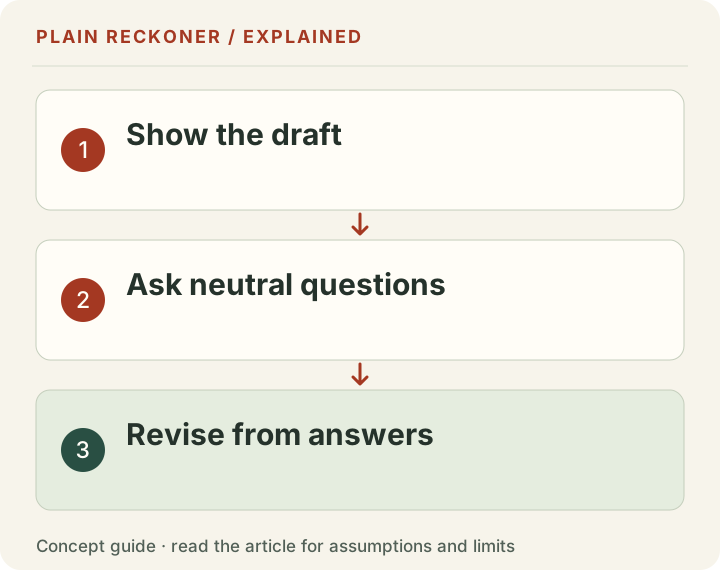
Show the draft to people who plausibly face the problem. Ask what is offered, who it appears to be for and what they would expect to happen next. Do not introduce the business with a speech that gives away the desired answers.
Record their wording before explaining your intention. If a reader thinks a bookkeeping service is a budgeting app, that mismatch is useful. A compliment such as “looks professional” does not resolve whether the offer was understood.
Use the same neutral questions for each draft. If you change the explanation midway through a session, preserve which version each participant saw. Otherwise, the responses become difficult to interpret and may appear more consistent than they were.
A small self-recruited group provides practical feedback, not a precise population-wide understanding rate. Keep the recruitment source and count visible. Five friends who know your business are not interchangeable with unfamiliar potential customers.
Decide what to change after feedback
Look for specific recurring misunderstandings rather than a vote on favorite wording. If readers cannot name the product, revise the category. If they understand the product but mistake the audience, change that context. If they expect a free service when it is paid, make the commercial step clearer.
Keep the previous version and the responses attached to it. A useful history shows the change and the reason, not merely the latest polished sentence. This lets the team avoid undoing a correction later because someone prefers the older phrase.
Do not interpret better recall as a completed sales result. A reader can understand an offer and decide it is unsuitable. That is sometimes a good outcome: the message has helped both sides avoid an unproductive enquiry.
The next stage is to place the sentence on a coherent page and observe the actual task. The Homepage Planner can help organize that page, while the Reader Check provides a place to record what people understood. Start with a clear draft, then let evidence guide the revision.
Before publishing, check the same wording in your business profile, email introduction and service page. Consistent meaning helps prevent a visitor from meeting a different offer at each step.